Best Binoculars for Bowhunting (2026): 6 Lightweight Picks
As an Amazon Associate we earn from qualifying purchases. How we choose
Best Binoculars for Bowhunting (2026): 6 Lightweight Picks
Bowhunting is a close-range game won in the dim minutes of dawn and dusk. You need glass that’s light on your chest, wide enough to find game fast, and bright when it counts. Here are the 6 best — scored and ranked.
⚠️ Disclosure: This guide contains affiliate links. As an Amazon Associate we earn from qualifying purchases (#ad) at no extra cost to you. We only recommend gear we’d trust in the field ourselves. Editor scores are our own hands-on assessments, not user-review averages.
Most bowhunters obsess over arrows, broadheads, and bow tuning — then sling a heavy, mediocre pair of binoculars around their neck. That’s backwards. Your binoculars are how you find the animal, judge it, and time your draw. In bowhunting, where everything happens close and fast in low light, the right glass is the difference between a filled tag and a story about the one that slipped past.
But bowhunting binoculars are a special breed. You don’t need 12x magnification or a five-pound boat anchor. You need something light enough to wear all day, wide enough to catch movement at the edge of shooting light, and bright enough to read antlers when the woods go gray. This guide ranks the 6 best binoculars for bowhunting in 2026 — five lightweight 8x42s and one ultralight compact — each with an editor score, star rating, full spec grid, and a direct link. Let’s get you glassing.
📋 What’s in this guide
Why Bowhunting Binoculars Are Different
Rifle hunters glass big country and shoot far, so they often want 10x or 12x power and big objective lenses. Bowhunting flips every one of those priorities. Your shot is usually inside 40 yards, your animal is close, and the action happens in thick cover or at the gray edges of the day. That changes what “best” means in a binocular:
- Light weight matters more than power. You’ll wear these on your chest from dark to dark, climb into stands with them, and crawl on stalks. Every ounce counts. The picks here run ~12–24 oz.
- A wide field of view wins. Lower 8x magnification gives you a wider view, so you catch the flick of an ear or a moving deer faster — and follow it through the brush.
- Low light is everything. Mature bucks move at first and last light. A 42mm lens at 8x produces a fat 5.25mm exit pupil that floods your eye with light when it’s nearly dark.
- Steady beats shaky. At 8x you can hand-hold a rock-steady image from a kneeling stalk or a swaying tree stand — no tripod needed.
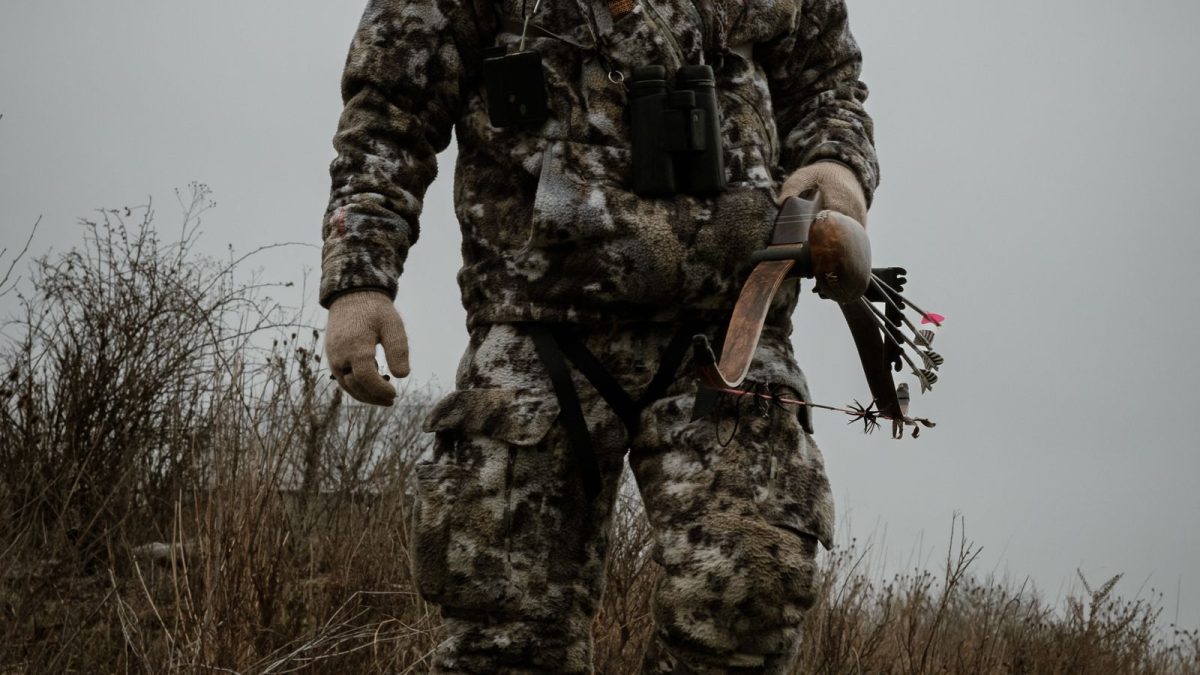
- It has to be quiet and ready. Paired with a chest harness, the right binocular sits silent and snaps to your eyes without banging your bow.
💡 Key insight: The best bowhunting binocular isn’t the most powerful — it’s the one you’ll actually carry all day and can trust in the last five minutes of legal light. That points straight at a lightweight, bright 8×42.
That’s the lens we used to judge every pick below. We weren’t chasing the longest reach; we were chasing the lightest, widest, brightest, most carry-friendly glass that helps you find, judge, and close on animals at bow range.
How We Tested & Scored
These picks were judged the way a bowhunter actually uses binoculars — worn all day in a harness, glassing field edges and timber at first and last light, and put to work judging racks at 30–80 yards. Our editor score (out of 10) blends four weighted categories you’ll see as sub-score bars in every review:
- Optical clarity (30%): resolution, contrast, color, and how cleanly the glass renders an antler against brush.
- Low-light performance (30%): brightness in the dawn and dusk windows when mature animals move — weighted heavily because that’s bowhunting’s money time.
- Weight & ergonomics (20%): carry comfort, balance, focus feel, and how well it disappears in a harness.
- Value (20%): performance per dollar and the strength of the warranty.
We focused on the configuration that fits bowhunting best — 8×42 — for five of the six picks, plus one ultralight 10×28 compact for spot-and-stalk minimalists. Prices move around, so we list an approximate street price and link you to the live Amazon listing for today’s number.
What to Look For in a Bowhunting Binocular
Master these seven ideas and you can judge any binocular for archery season — not just the ones on this list.
1. Magnification: 8x is king
For bowhunting, 8x is the sweet spot. It delivers a wider field of view than 10x (easier to find and track close animals), a brighter low-light image, and a steadier hand-held view. You’re not reaching across canyons — you’re confirming a buck at 60 yards and watching for your moment. Save 10x for open western terrain.
2. Objective lens & exit pupil
A 42mm objective is the bowhunter’s friend. Divide it by the magnification and you get the exit pupil — the column of light hitting your eye. An 8×42 gives a generous 5.25mm, near the limit of what your pupil dilates to at dusk. That’s why an 8×42 looks so bright when legal light is fading. Compacts (like a 10×28) drop to ~2.8mm — fine in daylight, dimmer at dawn.
3. Weight (carry it all day)
Bowhunting is mobile. You’ll hike in the dark, sit, stalk, and climb. A full-size 8×42 should land around 21–24 oz; an ultralight compact can be under 13 oz. A few ounces feels like nothing in the store and like a brick by hour ten. Lighter glass gets carried — and used — more.
4. Field of view (FOV)
FOV is how wide a slice you see at 1,000 yards. Wider is better for bowhunting because it helps you catch movement and follow animals through cover. At 8x, anything over ~390 ft is excellent (the Leupold Alpine HD hits a huge 426 ft). It’s one more reason 8x beats 10x for close work.
5. Low-light glass & coatings
Demand ED or HD glass, fully multi-coated lenses, and phase-corrected, dielectric-coated roof prisms. These push light transmission high and control the color fringing that makes cheap glass look muddy. They’re exactly what lets you read antlers in the last five minutes of shooting light.
6. Eye relief & harness fit
If you shoot in a face mask or glasses, look for 15mm+ of eye relief. And plan for a chest harness from day one — it’s how bowhunters carry glass silently and keep it ready without it swinging into the bow. See our best binocular harness guide.
7. Durability & warranty
Bowhunting is hard on gear — rain, sweat, brush, and the occasional drop from a stand. Insist on a 100% waterproof, fogproof body and a strong warranty. Vortex’s no-fault VIP and Maven’s unconditional lifetime warranties mean a damaged binocular gets fixed or replaced, period.
Quick Comparison: 6 Best Bowhunting Binoculars
| Binocular | Config | FOV @1000yd | Weight | Eye Relief | Score |
|---|---|---|---|---|---|
| Vortex Diamondback HD 🏆 | 8×42 | 393 ft | 21.8 oz | 17 mm | 9.3 |
| Maven C1 | 8×42 | 393 ft | 24.5 oz | 16 mm | 9.2 |
| Leupold BX-2 Alpine HD | 8×42 | 426 ft | 24.3 oz | 17 mm | 9.0 |
| Bushnell Engage EDX | 8×42 | 426 ft | 24.0 oz | 18 mm | 8.8 |
| Nikon Prostaff P7 💸 | 8×42 | 377 ft | 22.6 oz | 15.7 mm | 8.7 |
| Vortex Diamondback HD (compact) | 10×28 | 314 ft | 12.5 oz | 16 mm | 8.5 |
Specs are for the listed configuration; always confirm on the live listing. Editor scores are our hands-on assessments.
The 6 Best Binoculars for Bowhunting
1. Vortex Diamondback HD 8×42
4.7/5 · HD glass, light, VIP lifetime warranty
The Diamondback HD is the binocular we’d hand to nine out of ten bowhunters. It nails everything archery season demands: HD glass with dielectric, phase-corrected prisms for a bright, crisp image; a wide 393-ft field of view; a fat 5.25mm exit pupil for those last gray minutes; and a featherweight 21.8-oz body that disappears in a harness. Add Vortex’s no-questions VIP lifetime warranty and an included GlassPak case, and you have the best balance of price, performance, and peace of mind in bowhunting.
Pros
- Bright HD glass for the price
- Light 21.8 oz, easy all-day carry
- Wide FOV + 5.25mm exit pupil
- VIP unconditional lifetime warranty
Cons
- Edges soften slightly vs. alpha glass
- Focus wheel a touch fast for some
Verdict: The bowhunter’s default. Light, bright, tough, affordable, and warrantied for life — buy it and get back to shooting your bow.
2. Maven C1 8×42
4.7/5 · ED glass, lifetime warranty, direct-to-consumer
If you want the sharpest image on this list, the Maven C1 is it. Sold direct so your money buys glass instead of markup, it pairs ED glass, fully multi-coated lenses, and dielectric phase-corrected prisms for a bright, high-contrast, color-accurate view that punches into alpha territory. The 393-ft field of view and generous eye relief make it easy to glass for hours, and every Maven carries an unconditional lifetime warranty. It’s the upgrade pick for the bowhunter who lives behind the glass.
Pros
- Sharpest glass on this list
- ED lenses, alpha-like contrast
- Unconditional lifetime warranty
- Customizable, direct-to-consumer
Cons
- Heaviest full-size here (24.5 oz)
- Mainly sold direct/online
Verdict: The glass connoisseur’s pick. Spend a little more, see a little more — and never worry about the warranty again.
3. Leupold BX-2 Alpine HD 8×42
4.6/5 · 426-ft FOV, includes harness + tripod adapter
The BX-2 Alpine HD is a bowhunting bargain that arrives ready to hunt. It packs HD calcium-fluoride glass and Leupold’s water-shedding Guard-ion coating into a light, open-bridge body — and crucially, it has the widest field of view on this list at 426 ft, perfect for catching movement in tight timber. Even better, it ships with a chest harness, tripod adapter, and lens covers in the box, so you’re set up to bowhunt the day it arrives, backed by Leupold’s lifetime guarantee.
Pros
- Widest FOV here (426 ft)
- Harness + tripod adapter included
- Guard-ion sheds rain & fog
- Close 4.6-ft focus, lifetime guarantee
Cons
- Glass a step behind Maven/Vortex
- Included harness is basic
Verdict: The best out-of-the-box bowhunting value — widest view on the list and everything you need to hunt in one box.
4. Bushnell Engage EDX 8×42
4.5/5 · ED Prime glass, EXO Barrier, magnesium body
Bushnell’s Engage EDX brings premium features to a mid-tier price. ED Prime extra-low-dispersion glass virtually eliminates color fringing for a clean, contrasty image, while the famous EXO Barrier coating sheds water, oil, and dust so rain beads and wipes right off — a real edge for wet, pre-dawn sits. A lightweight magnesium chassis, a 426-ft field of view, a locking diopter, and generous eye relief round out a binocular built to glass hard in low light without breaking the bank.
Pros
- ED Prime glass kills fringing
- EXO Barrier sheds rain & fog
- Wide 426-ft FOV, 18mm eye relief
- Light magnesium chassis
Cons
- Warranty not fully no-fault
- Less resale/name cachet
Verdict: A lot of premium glass for the money — especially if your bow sits get wet. The EXO Barrier alone earns its spot.
5. Nikon Prostaff P7 8×42
4.6/5 · phase-corrected, locking diopter, ~$150
Dollar for dollar, the Prostaff P7 is the smartest entry into real bowhunting glass. For around $150 Nikon gives you phase-correction and dielectric high-reflective prism coatings, fully multilayer-coated lenses, and a handy locking diopter — features usually found on pricier binoculars. It’s light, fully waterproof and fogproof, and its bright, sharp image easily out-glasses anything in the under-$150 bargain bin. A perfect first serious binocular or a no-guilt truck-and-treestand backup.
Pros
- Phase-corrected, dielectric prisms
- Locking diopter — rare at this price
- Light, fully waterproof
- Outstanding value at ~$150
Cons
- Longer 9.8-ft close focus
- Slightly shorter eye relief
Verdict: The best cheap bowhunting binocular, period. Premium features at a beginner price, with a bright image that belies the cost.
6. Vortex Diamondback HD 10×28 (Compact)
4.5/5 · ultralight 12.5 oz, HD glass, VIP warranty
When ounces are everything — backcountry spot-and-stalk, run-and-gun, or a pocketable stand backup — this 12.5-oz compact is a joy to carry. It brings the same HD optical system and dielectric, phase-corrected prisms as its big brother into a package that vanishes in a bino pouch or jacket pocket, plus 10x reach to pick apart distant terrain. The honest trade-off is low light: the small 28mm lenses give a 2.8mm exit pupil, so it shines in daylight and dims at true dusk. Backed by the same VIP lifetime warranty.
Pros
- Ultralight 12.5 oz, pocketable
- Sharp HD glass for a compact
- 10x reach for terrain scanning
- VIP unconditional lifetime warranty
Cons
- Small 2.8mm exit pupil — dimmer at dusk
- Narrower FOV than a 42mm 8x
Verdict: The ultralight specialist. Not your dawn/dusk glass, but unbeatable when every ounce on your back matters.
🏹 Not sure which to grab?
Get the binocular nine out of ten bowhunters should buy: light, bright HD glass with the best no-fault warranty in optics, around $230.
See the Vortex Diamondback HD 8×42 on Amazon →
#ad · Our Editor’s Choice for bowhunting
Which Bowhunting Binocular Is Right for You?
Every pick here will serve you well. The best one depends on your style and budget:
| If you… | Buy this | Why |
|---|---|---|
| Want one do-it-all bow binocular | Vortex Diamondback HD 8×42 | Best balance of glass, weight, price, warranty |
| Want the sharpest possible image | Maven C1 8×42 | ED glass, alpha-like contrast |
| Want a complete ready-to-hunt kit | Leupold BX-2 Alpine HD | Widest FOV + harness & adapter included |
| Hunt wet, dim, rainy sits | Bushnell Engage EDX | ED glass + EXO water-shedding coating |
| Are on a tight budget | Nikon Prostaff P7 | Phase-corrected glass for ~$150 |
| Hunt fast-and-light spot-and-stalk | Vortex Diamondback HD 10×28 | Ultralight 12.5 oz, pocketable 10x |
Still deciding between the top two? Choose the Vortex Diamondback HD 8×42 for the best all-around value and the no-fault warranty. Step up to the Maven C1 8×42 if you spend serious time behind the glass and want the sharpest, most relaxing view. Either way you’re getting bright, lightweight, bowhunting-perfect glass. If you also chase deer from the stand, our deer hunting binocular guide pairs perfectly with this list.
8x vs 10x for Bowhunting: The Honest Answer
This is the question every bowhunter asks, so let’s settle it. For pure bowhunting, 8x wins — and here’s the why, not just the what.
Bow shots are close. You’re not identifying a buck at 600 yards; you’re confirming one at 60 and timing a 30-yard shot. At that range, 8x gives you three real advantages: a wider field of view (so you find and follow animals faster in cover), a brighter image (that fat 5.25mm exit pupil at dawn and dusk), and a steadier hand-held picture (less shake from a tree stand or kneeling stalk). A 10x magnifies not just the animal but every tremble of your hands and every sway of the tree.
So when does 10x make sense for a bowhunter? Only if you double as a spot-and-stalk or western hunter who glasses wide-open country to locate animals far off before closing the distance with your bow. In that case, the extra reach helps you pick apart distant slopes. That’s exactly why our compact pick is a 10×28 — it’s the “find them from afar, then stalk in” tool. For timber, tree stands, and most whitetail bowhunting, stick with 8×42. If you want a deeper breakdown, our 10×42 guide covers the open-country side.
🏹 Simple rule: Tree stand, timber, whitetails, close cover → 8×42. Wide-open spot-and-stalk where you glass long before you close → consider 10x. When in doubt, 8×42.
Common Mistakes (and How to Fix Them)
Even great glass underperforms if you buy or use it wrong. Dodge these bowhunting traps:
❌ Mistake 1: Buying too much magnification
The fix: Resist the urge to “go big” with 10x or 12x for bowhunting. The higher power narrows your view, dims the image, and shakes more in your hands. An 8×42 finds close animals faster and stays brighter when it counts. Power is not the goal — usable image is.
❌ Mistake 2: Skipping the harness
The fix: A neck strap lets your binocular swing into your bow, bang the tree stand, and bounce on every step. A chest harness holds it silent, ready, and protected. For bowhunting it’s not optional — it’s the difference between a clean draw and a busted stalk.
❌ Mistake 3: Ignoring low-light performance
The fix: Bucks move at the edges of light, so a binocular that dims at dusk fails you exactly when you need it. Choose a 42mm objective for that 5.25mm exit pupil, and don’t expect a tiny compact to glass well at last light. Match the tool to the moment.
❌ Mistake 4: Never setting the diopter
The fix: Out of the box your binocular isn’t matched to your eyes. Set the diopter once — focus the left barrel with your right eye closed, then sharpen the right barrel using only the diopter ring. The image gets noticeably crisper, and a locking diopter (Nikon P7, Bushnell EDX) keeps it there.
❌ Mistake 5: Cleaning lenses with your shirt
The fix: Sweat-soaked flannel and grit scratch coatings. Keep a microfiber cloth or lens pen in your harness pocket and clear fog and rain gently. Protect the coatings and your glass will stay bright for decades under warranty.
Pro Tips From the Field
Real-Life Examples: What Bowhunters Actually Say
Spec sheets tell half the story. Here’s how these binoculars earn their reputations in the field, drawn from common bowhunter experiences and reviews:
The “it found the buck I’d have missed” moment. A whitetail bowhunter glassing from his stand at last light catches an antler tip flick 80 yards out through his Diamondback HD — a mature 8-pointer slipping along a creek. Twenty quiet minutes later the buck is at 25 yards. Without the binoculars, he never knows it’s coming. This is the bread-and-butter value bowhunters cite again and again: the glass buys you time.
The spot-and-stalk minimalist. Western bowhunters chasing mule deer and antelope love a lightweight compact like the Diamondback HD 10×28 for the same reason ultralight backpackers love titanium — when you’re covering miles and crawling the last 100 yards, 12.5 ounces beats 24 every time. They’ll often carry the compact for mobility and keep a full-size 8×42 in the truck for glassing at camp.
The “I judged him before I drew” save. A new bowhunter resists the urge to shoot a buck at 35 yards, glasses him with a Maven C1 first, and realizes it’s a young 2.5-year-old — passing for a bigger deer later that week. Hunters constantly credit good binoculars with helping them not punch a tag on an immature animal, which is exactly the discipline that grows great hunting.
🗣️ The recurring theme: Bowhunters who finally pair lightweight, bright glass with a good harness say the same thing — “I use them constantly now.” The right binocular stops being dead weight and becomes the tool that finds, judges, and times nearly every encounter.
Frequently Asked Questions
Do you really need binoculars for bowhunting?
Yes. Even though shots are close, you use binoculars to spot game first, judge antlers, read body language to time your draw, and scan trails and cover from a stand. They also save your legs on spot-and-stalk hunts. A lightweight 8×42 is the bowhunter’s sweet spot.
Is 8x or 10x better for bowhunting?
For most bowhunting, 8x — it gives a wider view to find close animals fast, a brighter dawn/dusk image, and a steadier hand-held picture. Choose 10x only if you also glass wide-open western country before stalking in.
What size binoculars are best for bowhunting?
A full-size 8×42 is the best all-around size: bright 42mm lenses for low light, a wide steady 8x view, all in a ~22–24 oz body. For fast-and-light spot-and-stalk, an ultralight 10×28 compact (under 13 oz) is a great second option, though it gives up some low-light reach.
How much should a bowhunter spend on binoculars?
The sweet spot is about $150–$300. Binoculars like the Vortex Diamondback HD, Nikon Prostaff P7, and Leupold BX-2 Alpine HD give you ED-class glass, full waterproofing, and strong warranties. Because bow ranges are short, pricier alpha glass buys low-light and edge sharpness most bowhunters never need.
Why do bowhunters use a harness instead of a neck strap?
A chest harness holds your binoculars tight so they don’t swing into your bow or bang the stand, keeps them silent and instantly ready, protects them, and spreads the weight on long hikes. Many also hold a rangefinder and calls — making them a bowhunter’s command center.
Can binoculars help me judge a buck before the shot?
Definitely. Good glass lets you count points, gauge width and mass, and confirm a mature animal before you draw — so you don’t burn a tag on a young buck. Clear, bright glass makes this possible in the dim minutes when mature bucks usually move.
✅ Final Bowhunting Binocular Checklist
- Choose 8×42 for the best mix of wide view, brightness, and steadiness (10x only for open-country stalking).
- Demand ED/HD glass with fully multi-coated lenses + phase-corrected, dielectric prisms.
- Prioritize low light: a 42mm objective gives the bright 5.25mm exit pupil for dawn/dusk.
- Keep it light — aim for ~22–24 oz full-size, or under 13 oz for an ultralight compact.
- Confirm waterproof & fogproof sealing for wet, pre-dawn sits.
- Budget for a chest harness — non-negotiable for bowhunting.
- Favor a no-fault lifetime warranty (Vortex VIP, Maven lead here).
- Set the diopter the day it arrives for a sharper image.
- Buy from an authorized seller and register to keep coverage valid.
The Bottom Line
Bowhunting rewards the hunter who sees first. The right binocular — light, bright, and wide — finds the animal, judges it, and times your draw, all from the dim edges of the day when it matters most. You don’t need to spend a fortune; you need the right glass for close-range, low-light work.
If you want one pick to act on now: the Vortex Diamondback HD 8×42 is the do-it-all bowhunting binocular nine out of ten archers should own. Want the sharpest view? Step up to the Maven C1 8×42. Counting dollars? The Nikon Prostaff P7 punches way above $150. Going ultralight? Pocket the Diamondback HD 10×28.
Whatever you choose, pair it with a good harness and you’ll wonder how you ever hunted without it. For more setup help, explore our guides to the best low-light binoculars, best compact binoculars, and best hunting binoculars under $600. See more, draw smarter, fill your tag. 🏹
Reviewed by Cole Whitaker, Backcountry Hunting Optics Editor. Editor scores reflect hands-on field assessment. Prices and specs vary by retailer and production run — confirm current details on the live Amazon listing before purchase. Last updated June 26, 2026.